The Different Types of Scoliosis Braces Explained
Scoliosis is a spinal condition that causes the spine to curve sideways and rotate, potentially affecting posture, body alignment and overall spinal development. While some cases of scoliosis require little more than regular monitoring, others may benefit from treatment to prevent the spinal curve from becoming more severe.
One of the most common non-surgical treatment options for children and teenagers with scoliosis is bracing. A scoliosis brace is specially designed to apply corrective pressure to the torso, helping manage spinal curvature while the patient continues to grow.
However, not all scoliosis braces are the same. Different brace designs use different corrective techniques and are suitable for different spinal curve patterns, ages and treatment requirements.
Understanding the different types of scoliosis braces can help patients and parents feel more confident when discussing treatment options with their healthcare professionals.
In this guide, we explain the most common types of scoliosis braces, how they work and what factors determine which brace may be appropriate.
The Different Types of Scoliosis Braces Explained
What Is a Scoliosis Brace?
A scoliosis brace is a medical device worn around the torso to help manage spinal curvature and reduce the risk of curve progression.
Most scoliosis braces are designed for children and adolescents who are still growing and have moderate spinal curves that may become more severe during development.
Unlike ordinary back supports, scoliosis braces are specifically designed to address the three-dimensional nature of spinal curvature. They apply targeted pressure to selected areas of the body while allowing space in other areas to encourage improved alignment.
The primary goal of bracing is to prevent further curve progression rather than guarantee permanent correction of the spine.
The type of brace recommended depends on several factors, including the patient’s age, spinal curve location, curve severity and skeletal maturity.
What Are the Different Types of Scoliosis Braces?
There are several types of scoliosis braces available, ranging from traditional rigid braces worn throughout the day to specialised designs intended for nighttime use.
Each brace has specific characteristics and treatment applications.
1. Boston Brace
The Boston Brace is one of the most widely used types of scoliosis braces. It is a thoracolumbosacral orthosis (TLSO), which generally extends from below the chest to the hips.
The brace is typically made from rigid plastic and is custom-fitted or adjusted to the patient’s body shape and spinal curve.
It works by applying targeted pressure to specific areas of the torso to help manage spinal alignment. Expansion areas are incorporated into the design to allow the body to move into a more favourable position.
Key features of the Boston Brace:
Generally worn for approximately 18 to 23 hours per day, depending on the prescription.
Designed to fit underneath everyday clothing.
Commonly prescribed for adolescent idiopathic scoliosis.
Provides corrective pressure to selected areas of the torso.
The Boston Brace is often recommended for patients with suitable thoracic, lumbar or thoracolumbar curves.
2. Chêneau Brace
The Chêneau Brace is a custom-designed scoliosis brace that focuses on the three-dimensional correction of spinal curvature.
Unlike some traditional brace designs, the Chêneau approach places particular emphasis on addressing both sideways spinal curvature and trunk rotation.
It uses strategically positioned pressure areas and expansion spaces to help guide the torso into a more favourable alignment.
Key features of the Chêneau Brace:
Custom-designed according to the patient’s individual anatomy.
Addresses spinal curvature and trunk rotation.
Uses pressure zones and expansion areas.
Can be adapted to different spinal curve patterns.
The Chêneau Brace may be suitable for patients with more complex curve patterns, depending on their individual clinical assessment and the expertise of the orthotist.
3. Wilmington Brace
The Wilmington Brace is another type of thoracolumbosacral orthosis commonly used for adolescent scoliosis.
It is custom-moulded to the patient’s torso and generally provides corrective pressure through a close-fitting plastic design.
Unlike some braces assembled from standard components, the Wilmington Brace is designed around an individual mould of the patient’s body.
Key features of the Wilmington Brace:
Custom-moulded to the patient’s torso.
Provides targeted corrective pressure.
Generally worn underneath clothing.
Commonly prescribed for growing adolescents with scoliosis.
The brace is designed to help control spinal curvature while the patient continues to develop.
4. Charleston Bending Brace
The Charleston Bending Brace is a specialised brace designed primarily for nighttime use.
Unlike traditional daytime braces that aim to maintain a more upright position, the Charleston Brace places the patient’s torso into an intentional corrective bending position.
This positioning is designed to counteract the direction of the spinal curve while the patient sleeps.
Key features of the Charleston Bending Brace:
Primarily worn during sleep.
Uses corrective bending to address spinal curvature.
May be suitable for selected single-curve patterns.
Can provide an alternative to full-time bracing for appropriate patients.
Not everyone is suitable for nighttime bracing. Curve characteristics and clinical assessment are important when determining whether this option is appropriate.
5. Providence Brace
The Providence Brace is another nighttime scoliosis brace designed to apply corrective forces while the patient is lying down.
It uses targeted pressure to position the spine in a more corrected alignment during sleep.
The brace is generally prescribed for selected patients with suitable curve patterns, particularly certain lumbar and thoracolumbar curves.
Key features of the Providence Brace:
Designed primarily for nighttime wear.
Applies corrective pressure while lying down.
May be suitable for selected spinal curve patterns.
Offers an alternative to traditional daytime bracing.
As with other nighttime braces, patient selection is important to achieving appropriate treatment outcomes.
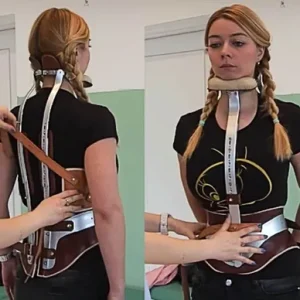
6. Milwaukee Brace
The Milwaukee Brace is an older type of scoliosis brace that includes a rigid pelvic section, a neck ring and vertical metal support bars.
It was historically used to manage different types of spinal curvature, particularly higher thoracic curves.
Although it is less commonly prescribed today because of the development of newer low-profile brace designs, it remains an important part of scoliosis bracing history.
Key features of the Milwaukee Brace:
Includes a neck ring and metal support structures.
Can address higher spinal curves.
Provides external corrective support.
Has a more noticeable design than modern underarm braces.
A specialist determines whether this type of brace is appropriate for a patient’s specific needs.
How Do You Choose the Right Scoliosis Brace?
Selecting the right scoliosis brace involves more than choosing a particular design. The brace must be appropriate for the patient’s spinal curve, physical development and treatment objectives.
Several factors influence the recommendation.
Spinal Curve Location
The location of the spinal curve is one of the most important considerations.
Some braces are better suited to thoracic curves, while others may be more appropriate for lumbar or thoracolumbar curves.
Curve Severity
The Cobb angle is used to measure the size of a spinal curve on an X-ray.
Healthcare professionals consider this measurement alongside other clinical information to determine whether bracing is appropriate and which design may be most suitable.
Age and Skeletal Maturity
Scoliosis bracing is generally most effective for growing children and teenagers.
The amount of remaining growth influences the treatment approach and may determine whether a full-time or nighttime brace is recommended.
Comfort and Lifestyle
Comfort is another important consideration because patients may need to wear their braces for many hours each day.
The brace should fit correctly, allow appropriate movement and be manageable during school, exercise and everyday activities.
How Long Do You Need to Wear a Scoliosis Brace?
The recommended wearing schedule depends on the type of brace and the patient’s treatment plan.
Traditional daytime braces, such as the Boston Brace, are commonly prescribed for approximately 18 to 23 hours per day.
Nighttime braces, including the Charleston and Providence designs, are generally worn while sleeping.
Consistency is essential. Research has shown that greater brace-wearing time is associated with improved outcomes in appropriately selected adolescents.
Patients should follow their orthotist’s instructions and attend regular appointments to ensure the brace continues to fit correctly as their bodies grow.
Are Custom Scoliosis Braces Better Than Standard Braces?
Many scoliosis braces are custom-made or individually adjusted because every spinal curve and body shape is different.
A custom-designed brace allows the orthotist to position corrective pressure according to the patient’s individual requirements.
However, the best brace is not necessarily the most complex or expensive option. Its suitability depends on the spinal curve, treatment goals and the expertise involved in its design and fitting.
Regular reviews are important to ensure that the brace continues to provide appropriate corrective support.
Conclusion: Finding the Right Scoliosis Brace
There are several different types of scoliosis braces available, each designed to address specific spinal curve patterns and treatment requirements.
From traditional daytime options such as the Boston and Wilmington braces to nighttime designs such as the Charleston and Providence braces, each option offers different features and potential benefits.
Choosing the right brace requires an individual assessment of spinal curvature, age, skeletal maturity and lifestyle requirements.
If you or your child has been diagnosed with scoliosis, consulting an experienced healthcare professional or orthotist can help identify the most appropriate treatment approach. With the right brace, consistent wear and regular monitoring, scoliosis bracing can help manage spinal curvature and reduce the risk of progression during growth.