Microprocessor Prosthetic Feet: Features, Benefits and Limitations
Microprocessor prosthetic feet are an advanced option designed to help people with lower-limb amputation move more comfortably and confidently across different environments. Unlike traditional prosthetic feet, which rely primarily on mechanical materials and fixed properties, microprocessor-controlled feet use sensors, electronics, and computer processing to respond to changes in movement.
For people considering a new prosthetic foot, understanding the technology is important. Microprocessor feet can offer greater adaptability in certain situations, but they also have limitations that should be considered before making a decision.
The most suitable prosthetic foot depends on individual mobility, goals, comfort, activity level, environment, and clinical needs. A prosthetist can help determine whether microprocessor technology is appropriate for your lifestyle.
What Is a Microprocessor Prosthetic Foot?
A microprocessor prosthetic foot is a prosthetic foot or ankle-foot system that uses electronic sensors and computer-controlled technology to adjust its behaviour during movement.
Sensors can collect information about the user’s position, movement, and interaction with the ground. A microprocessor then processes this information and controls components within the device.
Depending on the specific design, the system may adjust ankle resistance or position to help the user respond to different walking conditions. Some advanced devices can provide adaptive movement when walking on slopes or other changing surfaces.
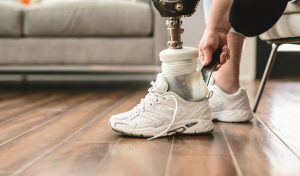
Microprocessor Prosthetic Feet: Features, Benefits and Limitations
How Does Microprocessor Technology Work?
The technology works by continuously monitoring movement and making adjustments based on the information detected by its sensors.
During walking, the foot experiences changing forces as the user loads and unloads the prosthesis. The system can interpret these changes and adjust its response.
This differs from a conventional prosthetic foot, where the characteristics of the materials and mechanical construction largely determine how the foot responds.
The exact features and control strategies vary between manufacturers and models, so users should discuss the specific technology of any device they are considering with their prosthetist.
Key Features of Microprocessor Prosthetic Feet
Microprocessor prosthetic feet can include several features designed to improve adaptability and support everyday mobility.
Adaptive Ankle Movement
One important feature is electronically controlled ankle movement. Depending on the device, the ankle may adjust its position or resistance to accommodate changes in terrain.
This can be particularly useful when walking on slopes, where a fixed ankle position may make it more difficult to maintain comfortable and efficient movement.
Sensor-Based Control
Sensors allow the prosthetic system to monitor movement and respond accordingly. Rather than depending entirely on preset mechanical characteristics, the device can use information gathered during each step to modify its behaviour.
This ability to respond dynamically is one of the main differences between microprocessor-controlled feet and traditional prosthetic feet.
Multiple Activity Modes
Some microprocessor prosthetic feet offer different modes or settings for specific activities. Depending on the product, these may include walking, standing, or other forms of mobility.
Some systems can automatically recognise changes in activity, while others may require the user or prosthetist to select a particular setting.
Rechargeable Batteries
Because microprocessor feet rely on electronic components, they require a power source. Many devices use rechargeable batteries.
Battery life and charging methods vary between products. Users need to understand the charging requirements and follow the manufacturer’s recommendations to maintain reliable operation.
Benefits of Microprocessor Prosthetic Feet
Microprocessor feet may provide several potential benefits for appropriately selected users.
Improved Adaptability
Adaptability is one of the most significant potential benefits. A conventional prosthetic foot generally has a consistent mechanical response, while a microprocessor foot can modify its behaviour according to movement and terrain.
This may help users transition between different surfaces and manage changes in slope more naturally.
Research into microprocessor-controlled ankle-foot prostheses has investigated their ability to improve mobility on slopes and other challenging surfaces. Studies have reported potential functional benefits compared with conventional prosthetic ankle designs.
Support on Slopes
Slopes can present a particular challenge for people using prosthetic feet. A fixed ankle may require the user to compensate through changes in posture, knee movement, or walking technique.
An adaptive microprocessor ankle can change its position or resistance to better accommodate the angle of the surface.
This may help some users feel more stable and comfortable when walking uphill or downhill.
Potential Improvements in Comfort
By adapting to different walking conditions, a microprocessor foot may reduce the need for some compensatory movements.
This can potentially improve comfort during everyday activities, although individual results vary. Socket fit, alignment, residual limb health, strength, footwear, and walking technique all influence overall comfort.
Greater Confidence During Everyday Mobility
Confidence is an important part of successful prosthetic use. Knowing that a prosthetic foot can respond to changing conditions may help some users feel more comfortable when walking outdoors or navigating unfamiliar environments.
However, a microprocessor foot does not eliminate the need for rehabilitation, practice, or appropriate safety awareness.
Limitations of Microprocessor Prosthetic Feet
Despite their advanced technology, microprocessor feet are not suitable for every situation or every user.
Higher Cost
One of the main considerations is cost. Microprocessor technology is generally more complex than traditional prosthetic foot technology, and the initial cost can therefore be higher.
Funding arrangements vary depending on location, healthcare system, insurance, eligibility, and individual circumstances. Users should discuss funding and replacement requirements with their prosthetist or relevant funding provider.
Battery Dependence
Unlike many traditional prosthetic feet, microprocessor-controlled feet require electrical power.
Users need to charge the device regularly and understand how it behaves when the battery is low or depleted. This adds another practical consideration to everyday prosthetic management.
More Complex Maintenance
Microprocessor feet contain electronic components, sensors, batteries, and software. This can make maintenance and servicing more specialised than with a conventional mechanical foot.
Users should ask about servicing requirements, warranty coverage, repairs, and access to technical support before choosing a device.
Not Every User Needs Advanced Technology
Advanced technology does not automatically mean better outcomes for every individual.
Someone who mainly walks on level surfaces and has relatively predictable mobility requirements may find that a traditional energy-storing-and-returning foot provides sufficient function.
The goal should be to select a prosthesis based on individual requirements rather than simply choosing the most technologically advanced option.
Who May Benefit From a Microprocessor Prosthetic Foot?
A microprocessor prosthetic foot may be particularly worth considering for people who regularly walk in changing environments.
People Who Walk on Different Surfaces
If your daily activities involve slopes, ramps, uneven paths, grass, or other changing surfaces, adaptive ankle technology may provide useful advantages.
The ability to modify ankle behaviour can help accommodate changes that a fixed mechanical foot cannot actively respond to.
Active Community Ambulators
People who regularly walk outside the home and participate in a range of activities may benefit from a prosthetic foot designed for greater adaptability.
However, activity level alone should not determine the choice. A professional assessment is important to identify whether the technology matches the person’s specific needs.
How to Decide if a Microprocessor Foot Is Right for You
Choosing a prosthetic foot should involve more than comparing technical specifications. Consider how and where you use your prosthesis every day.
Discuss Your Daily Activities
Tell your prosthetist about the surfaces you walk on, the distances you travel, your typical walking speed, your footwear, work requirements, hobbies, and other activities that matter to you.
These details can help your prosthetist identify features that may provide meaningful benefits.
Ask About Trialling the Device
If a trial is available, using the prosthetic foot in realistic situations can help you understand how it feels and performs.
A trial may also help identify whether the additional technology provides meaningful improvements over your current prosthetic foot.
Making an Informed Choice
Microprocessor prosthetic feet represent an important development in prosthetic technology. Their sensors and computer-controlled systems can provide adaptive responses that may be useful when walking across slopes, uneven surfaces, and changing environments.
At the same time, they can involve higher costs, battery requirements, specialised servicing, and greater technical complexity.
There is no universally perfect prosthetic foot. The right choice depends on your mobility, physical abilities, lifestyle, environment, comfort, goals, and access to ongoing prosthetic care.
A qualified prosthetist can assess your individual requirements and explain whether a microprocessor-controlled foot is appropriate. By considering both the benefits and limitations, you can make a more informed decision and choose technology that supports the way you want to move.